Domenica del Corriere
Montenapoleone, five minutes of gunfire.
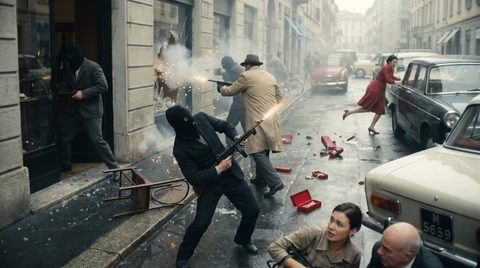
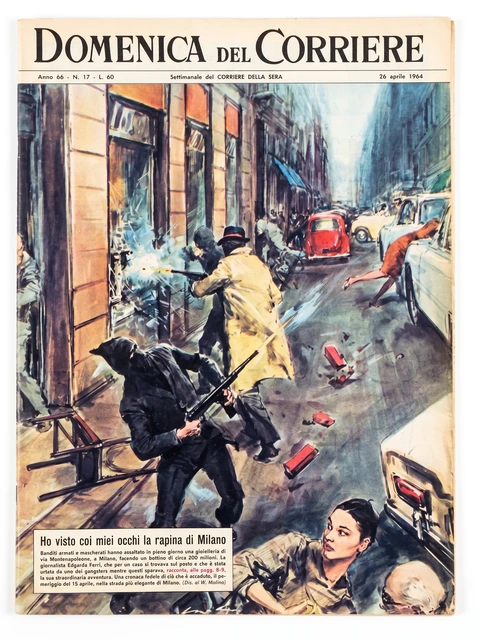
On 15 April 1964, the Colombo jewellery store at 12 via Monte Napoleone became the scene of a robbery that would enter the crime history of boom-era Milan. Eight men, four Alfa Romeo Giulias and a street blocked at gunpoint compressed the entire action into a few minutes.
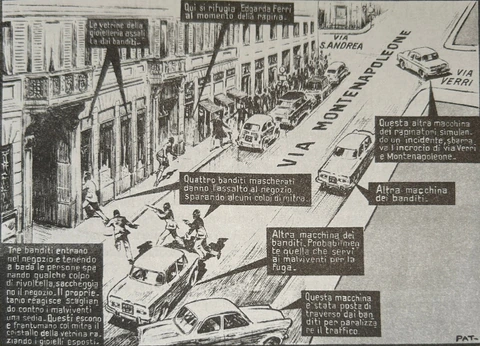
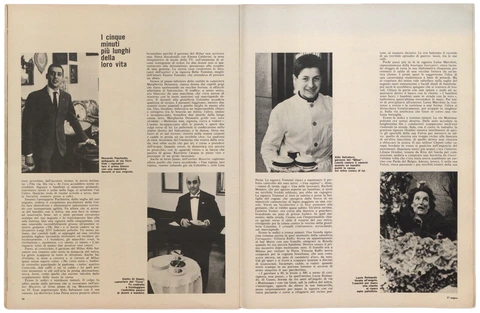
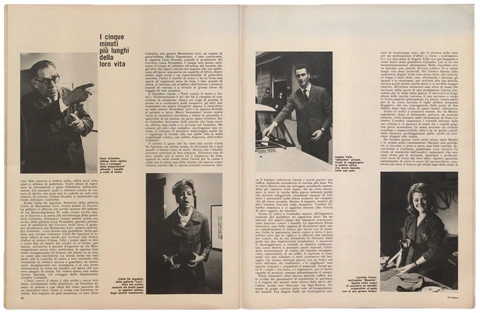
The starting point for this experiment is the report published by Domenica del Corriere on 26 April 1964. Text, cover illustration, escape diagram, photographs and testimonies are studied as parts of a single document to be turned into an audiovisual sequence.
The aim is to reconstruct the initial events with narrative continuity and attention to the sources: car positions, entry into the jewellery store, people involved, bystanders’ reactions and escape. The generated images are explicitly presented as visual interpretations of what the article describes, not as original archive material.
Cinematic reconstruction of the robbery
Before the images, a narrative script was written to order the robbery’s chronology and connect actions, places and testimonies. Its register combines documentary, noir and reportage: a voice reconstructs the events as the scenes show the elegance of via Monte Napoleone interrupted by arriving cars, gunfire and escape.
Some witnesses mentioned in the article were recreated from the published portraits and brought into the script through the experiences reported on the page. Faces, clothing, interiors and weather create plausible continuity with Milan in 1964, without confusing the reconstruction with filmed documentation of the event.
From the news
to the scene
The reconstruction starts by reading the pages. The published diagram clarifies the cars’ positions, access to the jewellery store, traffic blockade and direction of escape; photographs, captions and text add information about people, places and the sequence of events.
The witnesses’ portraits become references for recreating their features, age, clothing and context. Their statements guide the posture, tone and setting of interview scenes, while details from the report define shop windows, street, vehicles and objects in the action sequences.
Each element is first isolated and then connected to the others again. The research establishes visual boundaries for design rather than freely filling gaps: the sources determine what can be shown, and direction builds the transition from one fragment to the next.
Faces, places, testimonies
The results bring together reconstructed interviews, the crowd outside the jewellery store, the Colombo entrance, objects scattered on the street and characters shown in their surroundings. Each image corresponds to a passage in the script or a testimony in the article.
Costumes, cars, architecture, interiors and light remain consistent across scenes. Editing can thus move from a wide street shot to a witness close-up while retaining a single visual register, between illustrated news, reportage photography and cinematic reconstruction.
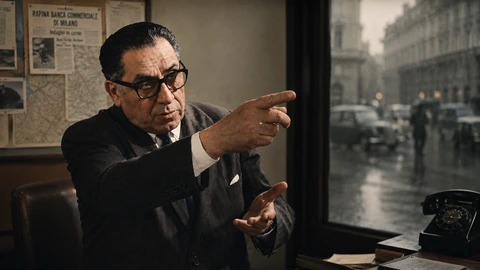
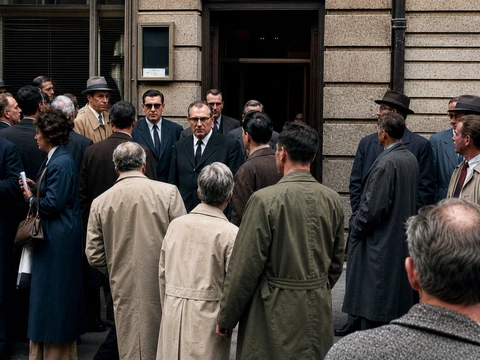
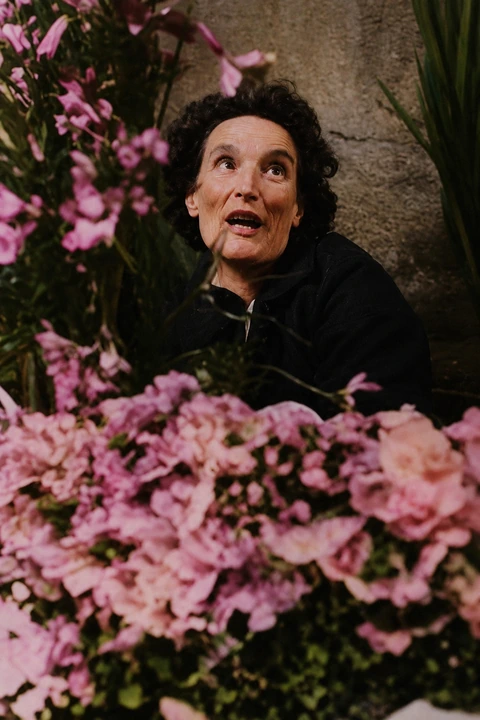
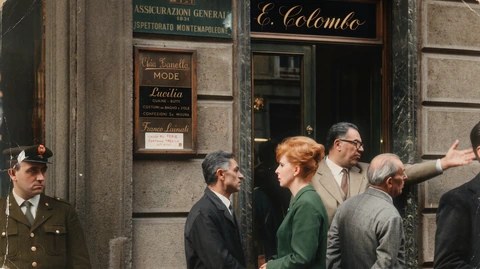
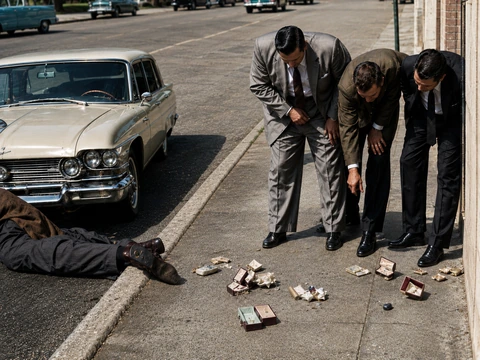
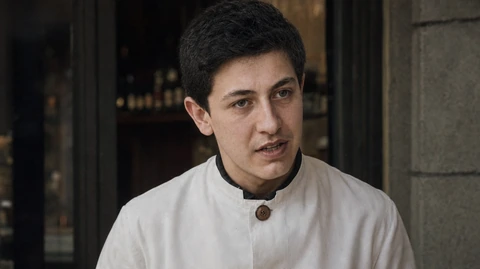
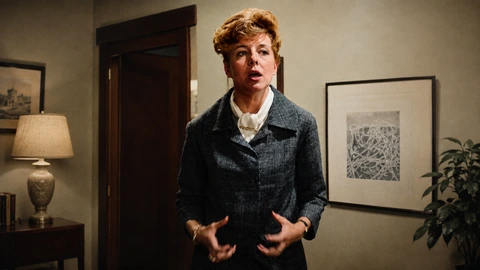
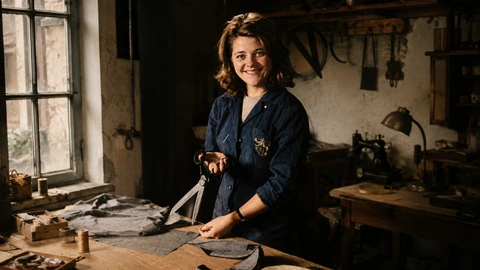
The colour images in this section are visual reconstructions made with artificial intelligence tools. The historical documents are presented separately in the preceding section.